
DBC Germany goes digital, betting on systems it builds itself
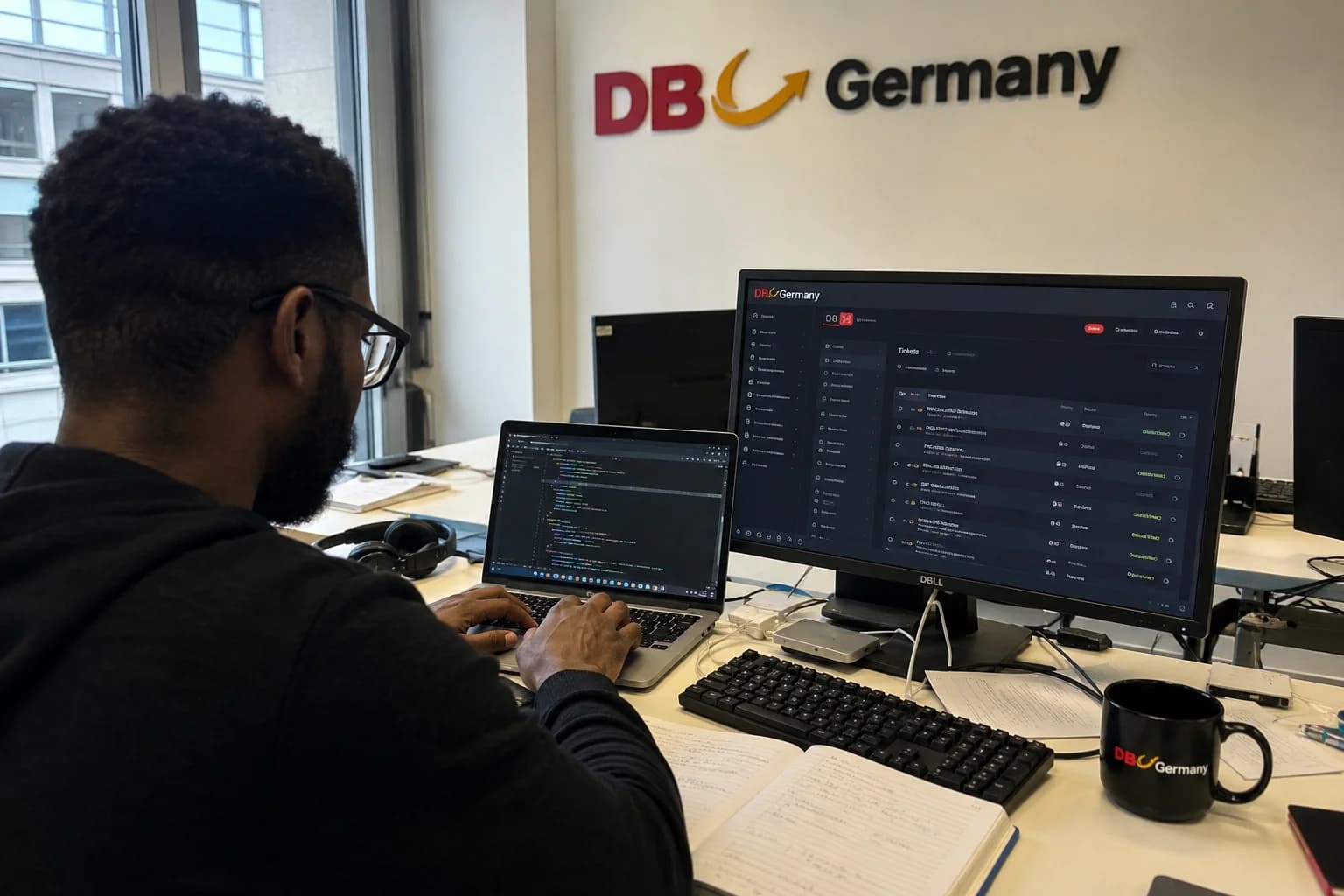
The Düsseldorf branch of Diambilay Business Center is trading rented software for an in-house ecosystem — and Richesses d’Afrique Masterclass Germany 2026 will be the first test.
DÜSSELDORF — DBC Germany is going digital, and it has decided to do it the hard way: by building its own software instead of renting it.
The German branch of Diambilay Business Center has brought in digitalization specialist Jay N. Kalala to build a connected set of in-house systems — a public website, an internal dashboard, a jobs board, a survey tool and a ticketing app — in English, German and French. The instruction, the branch says, was blunt: own the systems instead of stitching together someone else’s.
“We are living in a digitalized world and DBC Germany will not be the last to jump on that boat,” said Ruth Bambi, the branch’s CEO and a DBC ambassador, who started the project with a phone call to Kalala.
It is an easy thing to announce and an expensive thing to mean. Plenty of organizations say they are going digital and turn out to have bought a few subscriptions and a newsletter plugin. The distinction Bambi is chasing shows up later — the day the branch wants its software to do something the vendor never planned for. A specific ticket type. A survey in three languages. Every channel’s numbers on one screen. Rent the software and you file a support request and wait your turn. Own it and you set your own roadmap. For a branch built around live events and a fast-moving diaspora business audience, that control is the whole point.
Kalala — whose turn from critic of African business to builder DBC Germany has documented — is not new to this. A Congolese-born entrepreneur based in Germany, he has built and run production systems for African and international markets — ERP and SaaS platforms, mobile apps, web platforms. He founded Narikia, a company that builds systems to help other firms run with more transparency and less manual work. Much of his feel for scale comes from projects tied to Cologne’s trade-fair sector — the world of Koelnmesse, where software either holds up in front of thousands of visitors or fails in plain sight.
What he has been asked to build is less an app than a hub. The public website becomes the branch’s front door: events, news, careers and the network of DBC branches across countries. Behind it sits a single internal dashboard, where the team publishes to every public page and pulls each one’s performance back in — sign-ups, traffic, ticket scans, sales — instead of juggling ten logins. The ticketing platform, jobs board and survey tool are the parts the public will touch directly. All of it works in dark and light mode and in all three languages, because the audience reads in all three.
The first real test will be Richesses d’Afrique Masterclass Germany 2026, in Essen, the branch’s flagship event, where the ticketing app will sell and scan tickets for real. In Germany that is not only a design problem: selling tickets through your own software runs into the country’s fiscal and record-keeping rules, a question the branch says it plans to settle with a tax adviser before the doors open rather than discover on the night.
DBC Germany is one of nine country branches of Diambilay Business Center, alongside the DRC, Belgium, France, Canada, the United Kingdom, the United States, Gabon and Senegal, and sub-brands that include Richesses d’Afrique, DBC Agency and Formation Excellentia. Bambi’s wager is that a working in-house build in Germany becomes a template the rest of the network can copy — proof that a DBC branch can run on systems it controls, in three languages, without paying rent to a stack of vendors.
For now it is a plan on paper, and the branch is careful to say nothing is set in stone. The proof comes in 2026, when the doors open and the system either holds or it doesn’t.
More articles

Danyo Ilunga joins DBC Germany in Essen: the Congolese-German icon in the diaspora's corner
A five-time kickboxing world champion as guest of honour at a business gathering. The surprise fades the moment you know the story.
DBC Germany
DBC Germany: why Düsseldorf, and what awaits Essen on 13 June 2026
A pan-African business movement is planting its German flag in the Ruhr. The choice is surprising — until you read the map.
DBC Germany

From critic to builder: Jay N. Kalala and the digital backbone of DBC
He first challenged the story of African business from a France 24 panel. Now he is the one coding the Diambilay Business Center's digital backbone. The portrait of a turn.
DBC Germany